
For decades, management has treated strategy as the primary source of competitive advantage. Organisations invest heavily in strategic plans, transformation programmes, and growth priorities. Yet similar strategies often produce dramatically different results.
The explanation is usually reduced to “execution.” But that only moves the question one level deeper: what determines whether an organisation can execute?
The answer is capabilities.
Every organisation depends on a system of technical, operational, organisational, regulatory, digital, and human capabilities. Together, they form the operating system through which strategy is delivered.
Strategy defines intent. Capabilities determine whether that intent can become reality.
The problem is that leaders rarely manage capabilities directly. They manage business units, projects, budgets, products, and financial performance. These are important, but they are expressions of the underlying capability system—not the system itself.
As a result, organisations often optimise what is visible while the foundations of execution quietly weaken.
Not all capabilities matter equally. In every industry, a relatively small number account for a disproportionate share of competitive and economic value. These are the critical few: the capabilities that differentiate an organisation, constrain its growth, and determine how effectively it can adapt.
The critical few are also constantly changing. Artificial intelligence, automation, trade policy, regulation, demographic shifts, and emerging technologies continually redefine which capabilities matter most. What once differentiated a company can become a basic requirement. Capabilities that previously seemed peripheral can rapidly become central to competitiveness.
This has an important implication: strategic risk often accumulates long before it appears in revenue, margins, or market valuation.
Financial measures are lagging indicators. Capability structures can act as leading indicators. Weakness often appears first in capability gaps, execution bottlenecks, fragile dependencies, and the declining relevance of existing strengths. By the time the consequences become visible in financial performance, the organisation may have fewer options and less time to respond.
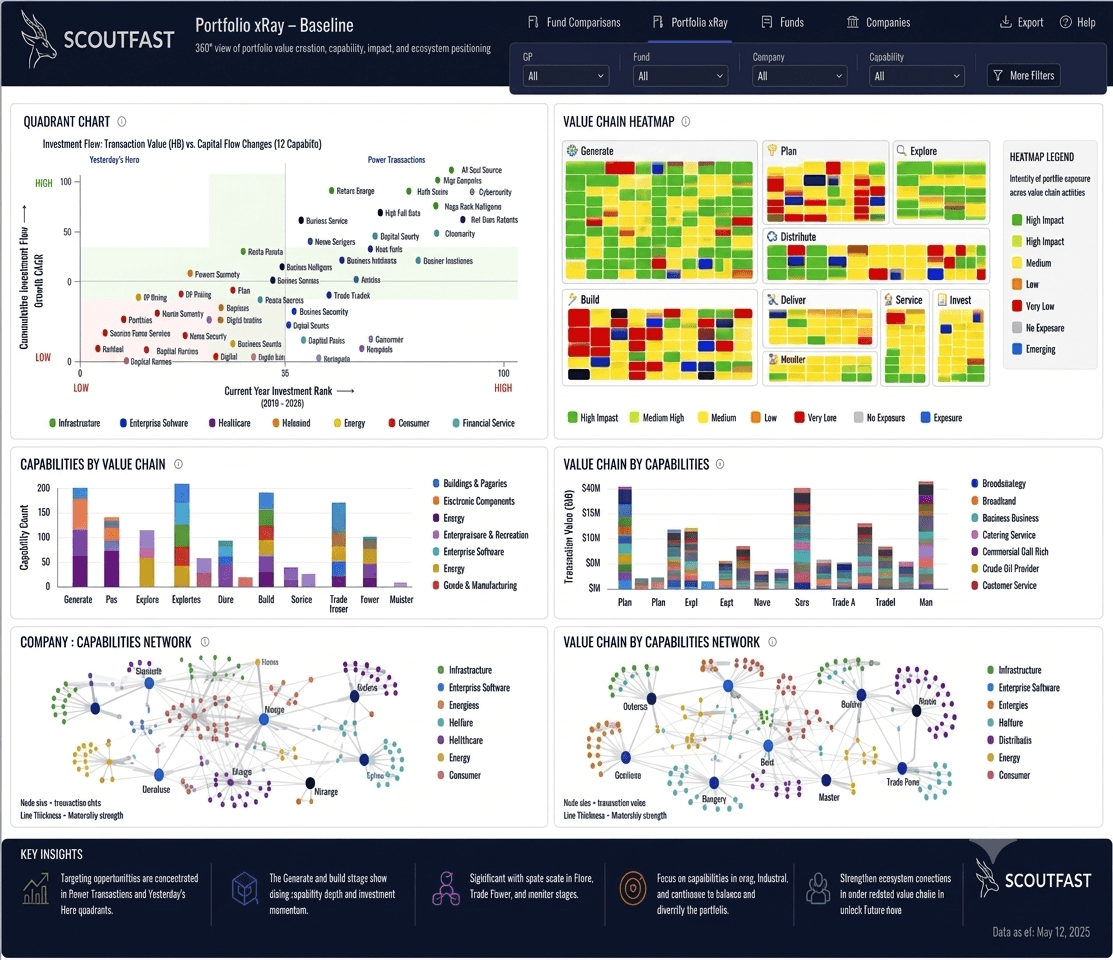
Advances in AI and network modelling are making these structures easier to see. Instead of evaluating organisations primarily through their products, markets, or financial results, leaders can examine the capabilities that create value, the dependencies that introduce fragility, and the capabilities becoming more—or less—economically important.
The strategic question therefore changes.
It is no longer only:
“What strategy should we pursue?”
It becomes:
“What capabilities must exist for this strategy to succeed—and do we possess them?”
This does not replace conventional strategy. It gives strategy a more practical foundation.
Capabilities are the building blocks through which organisations create economic value. Those that understand how capability systems evolve—and where value is migrating across them—can identify opportunity and risk before either becomes obvious through conventional measures.
That is the central idea behind Capability Economics: managing the leading indicators of competitive advantage, rather than reacting to the outcomes after they appear.