
Applications for capital, companies, and ecosystems.
Both applications use the same capability-economics foundation. Each is focused on a different decision environment.
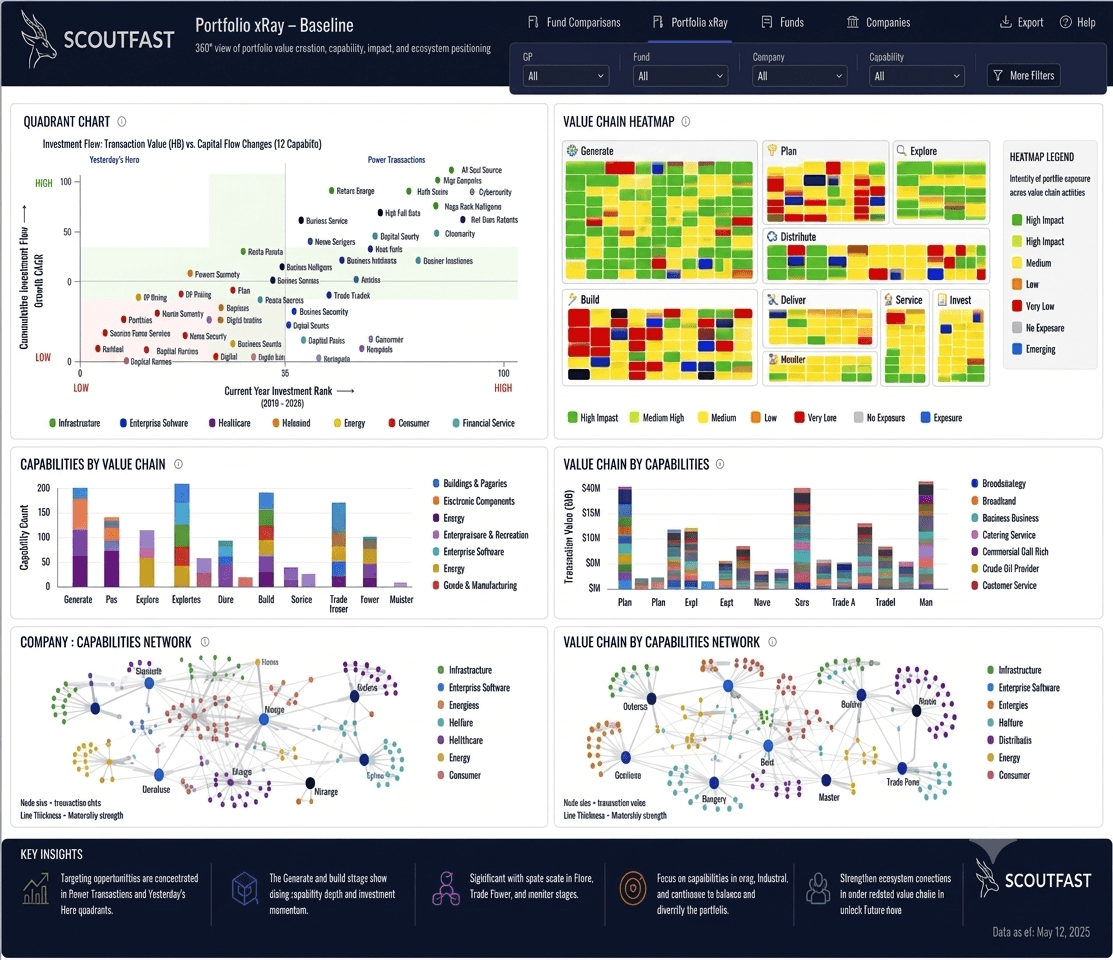
— shared framework
How the applications work
Map capabilities
We identify the capabilities that shape a company, sector, ecosystem, or investment thesis.
Connect actors and capital
We connect companies, investors, institutions, infrastructure, relationships, and market signals around those capabilities.
Reason over the graph
Specialized AI agents answer focused questions about fit, gaps, bottlenecks, adjacencies, and emerging opportunity.
Generate explainable outputs.
Users receive reports, dashboards, maps, rankings, recommendations, and decision-support briefs that show what matters and why.
SCOUTFAST
Before SCOUTFAST
Founders spend too much time building investor lists, guessing who is aligned, and trying to explain why they fit a funder’s thesis.
Investors rely on inbound deal flow, networks, sector labels, and obvious consensus themes. They may see companies, but not always the capability structure that explains fit, risk, or differentiated value.

After SCOUTFAST
Founders can identify better-fit funders, understand why they fit, and approach them with a sharper narrative.
Investors can find non-obvious companies, understand thesis fit, identify portfolio gaps, and see where capability clusters, chokepoints, or adjacencies are emerging.

What SCOUTFAST can help produce
- Founder-funder fit analysis
- Investor shortlists
- Capability-based company profiles
- Portfolio fit and gap analysis
- Opportunity maps
- Fundraising and investor-outreach narratives
- Market and capability monitoring
Example questions SCOUTFAST can help answer
- Which investors should I target?
- Why are they a fit?
- Which companies fit my investment thesis?
- How does this company fit into my portfolio?
- What capability gaps exist in this market?
- What adjacencies or partnerships could strengthen this company?
- Where is value shifting before others see it?
ORYQ
Before ORYQ
Ecosystem leaders rely on dashboards, reports, stakeholder interviews, and disconnected datasets.
They may know who is active in a sector, but not which capabilities are missing, where over-concentration exists, how actors are connected, or which interventions could create the greatest leverage.

After ORYQ
Ecosystem leaders can map a sector, geography, or strategic domain by capability.
They can see which companies, institutions, investors, infrastructure, and policy constraints are connected; where bottlenecks exist; where capital is flowing; and where programs, incentives, partnerships, or investment could have the greatest impact.

What ORYQ can help produce
- Ecosystem capability maps
- Sector intelligence dashboards
- Bottleneck and white-space analysis
- Capital-flow and actor maps
- Policy and investment decision support
- Intervention maps
- Market-entry and ecosystem-development briefs
- Recurring ecosystem intelligence reports
Example questions ORYQ can help answer
- Which capabilities exist in this ecosystem?
- Which are missing or underdeveloped?
- Where are the bottlenecks?
- Which actors are central to the ecosystem?
- Where is capital flowing?
- Which interventions may create the most leverage?
- How is the ecosystem changing over time?
Start focused. Expand over time.
SCOUTFAST and ORYQ can begin with a focused question, pilot, report, or market map. As data, users, and questions expand, the same foundation can support dashboards, recurring intelligence, natural-language exploration, and deeper integrations.
Typical delivery formats include PIVOT Reports, investor-fit reports, ecosystem maps, opportunity maps, dashboards, data extracts, recurring intelligence briefs, and custom market monitors.